
Swaged, interlock and one-piece hose fittings often appear as neighbouring categories in a hydraulic catalogue. It is tempting to read them as three competing options and ask which one is best. A better first question is what each name describes. One refers mainly to how a connection is formed, another to a retention concept, and another to how the fitting components are supplied.
These descriptions can overlap. A one-piece fitting may be permanently crimped onto a specified hose. An interlock design may also be assembled by crimping. Neither “one-piece” nor “interlock” establishes a universal pressure rating, and neither name confirms compatibility with a hose simply because the nominal size matches.
This guide uses HUALAI’s product directory to explain the categories and the information buyers should request. It is intended to help with selection and quotation discussions, not to provide a workshop crimping procedure.
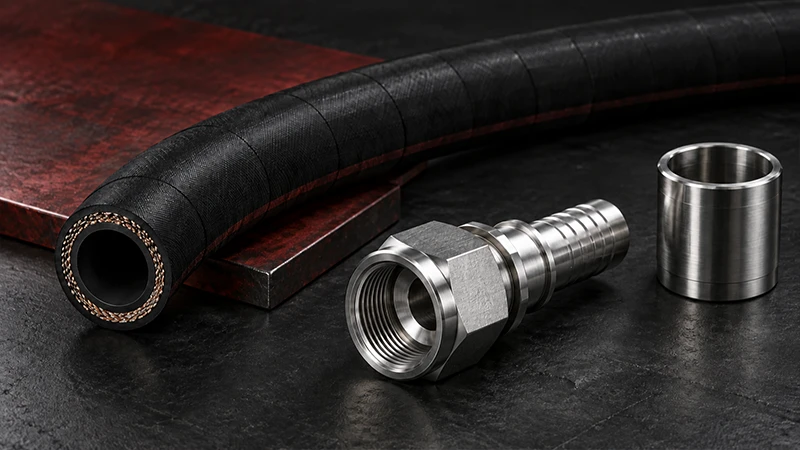
First Separate the Two Ends of a Hose Fitting
A hose fitting has two different interfaces to consider. The hose side connects to the flexible hose through the specified insert, shell or ferrule arrangement. The connection side joins the finished assembly to equipment or another component. Buyers sometimes identify the second interface accurately while leaving the first almost undescribed.
For example, “JIC female elbow” describes a useful part of a requirement, but it does not identify the hose manufacturer, hose series or approved attachment system. Equally, knowing that a fitting belongs to a one-piece range does not identify its external connection size or elbow orientation.
Keep those two questions separate on an enquiry form. Under “hose side,” record the hose identification and required fitting system. Under “connection side,” record the end standard, size, sealing arrangement and shape. This structure helps prevent a correct thread selection from being mistaken for a complete assembly specification.
For help with the connection side, see Metric, BSP, JIC & ORFS: Understanding Hydraulic Connections.
What the Three Descriptions Actually Tell You
| Description | What it primarily describes | What still needs confirmation |
|---|---|---|
| Swaged or crimped fitting | A permanent attachment formed by controlled deformation of the specified outer component | Approved hose, insert and ferrule combination; preparation; equipment and assembly data |
| Interlock fitting | A retention concept that engages the hose reinforcement through the specified design | Exact hose system, preparation requirements and applicable assembly instructions |
| One-piece fitting | A fitting supplied with its ferrule or shell already attached as a unit | Compatible hose series, fitting size, preparation and crimp specification |
Terminology varies between catalogues. Some suppliers distinguish swaging from crimping according to the tooling and process used. For procurement, preserve the supplier’s exact range name and ask for the assembly method associated with that range. Do not assume a general term authorises a particular machine setup.
Swaged Hose Fittings in a Product Directory
In common catalogue usage, a swaged hose fitting belongs to a permanent attachment system. Where the insert and ferrule are supplied separately, the purchaser needs the correct reference for both components. An insert selected only for its external connection may still require a different ferrule according to the approved hose system.
HUALAI’s directory contains a broad swaged hose fitting section. Its connection options include metric variants, BSP, JIC, ORFS, NPT and flange connections, along with additional specialised configurations. This breadth is useful when looking for the required equipment interface, but it does not make the hose attachment details interchangeable across all entries.
Consider a buyer searching for a BSP female straight fitting. Finding the relevant shape and thread in the directory answers the first catalogue question. The next questions concern the hose identification, the required size variant, the matching ferrule and the assembly documentation. Treat those as a second stage of selection instead of assuming the first visual match completes the task.
If you are purchasing components for your own assembly operation, state that clearly. If you need finished hose assemblies, say so at the beginning. Those are different enquiry scopes, and they affect which information is needed for the quotation and technical review.
Interlock Hose Fittings and Preparation Requirements
The interlock concept concerns mechanical retention involving the hose reinforcement. Parker’s hydraulic hose technical handbook describes designs that lock reinforcement between the shell and nipple. It also documents both skive and no-skive interlock systems. Consequently, “interlock” alone is not sufficient to determine whether internal or external hose material must be removed.
HUALAI’s interlock section is labelled in Chinese as fittings for hoses with internal and external skiving. That is useful information about the catalogue category. It is not a substitute for the preparation dimensions or assembly instructions for a specific approved combination.
The directory lists interlock flange configurations, including straight and angled forms. When using these entries, send the exact catalogue reference and ask which hose series and size are covered. If preparation is required, obtain the specified procedure rather than copying a method used on another manufacturer’s system.
Buyers should also distinguish between a flange category label and the rating of a completed hose assembly. A pressure-related number in a catalogue heading does not independently establish the allowable working pressure of every assembly that includes a fitting from that heading. The final selection requires the applicable component data and confirmation for the actual configuration.
One-Piece Hose Fittings: What Changes for Purchasing?
A one-piece fitting is generally supplied with the shell or ferrule attached to the fitting body. This changes how the components are handled and ordered: the buyer identifies a complete fitting unit instead of separately choosing a loose insert and ferrule for that design.
That packaging and construction difference can simplify a purchase line, but it does not remove the compatibility check. A one-piece fitting remains associated with particular approved hose applications and assembly data. A product advertised as no-skive also needs to be used within the scope of its own documentation; the description is not a universal permission to omit preparation on other products.
HUALAI’s directory includes an “Integral Hose Connector” section with metric, BSP, ORFS, JIC and flange options. References include H42611SW in the BSP group and H46711SW in the JIC group. Use those as directory references, and confirm the full size designation and applicable hose information before ordering.
For comparison, Gates provides product-specific descriptions for its spiral-wire hose coupling range. Such descriptions illustrate why construction claims should stay attached to a named product range. They do not establish compatibility or equivalent performance for another manufacturer’s fittings.
Choose a Documented System, Not a Favourite Label
The useful selection question is: which documented hose and fitting combination meets the application and can be assembled using the approved process? Starting with a favourite category, such as “always use interlock,” can bypass the information needed to answer that question.
Record the hose manufacturer, series, nominal size and any readable markings. If a standard designation is available, include it alongside the product identification. For a replacement, retain a photograph of the hose marking and the fitting reference rather than transcribing only the most prominent text.
Gates’ hydraulic hose catalogue specifically directs users to approved hose and coupling combinations and correct assembly data, and warns against mixing manufacturers’ products. The practical implication for an enquiry is to disclose the actual hose you intend to use. Do not treat an alternative fitting as approved merely because it can be physically inserted.
If the original hose cannot be identified, say so. Request a complete, documented replacement system or further identification assistance. This is more productive than requesting a matching-looking fitting and leaving the most consequential compatibility question unresolved.
Ask for the Assembly Data That Belongs to the Part
An order for loose hose fittings should identify what documentation the assembler needs. That may include the approved hose combination, preparation requirements, insertion information, applicable crimp data and inspection criteria. The specific documents depend on the product system and who will assemble it.
Avoid copying settings from a visually similar fitting or an old worksheet without confirming applicability. Gates’ eCrimp database provides a manufacturer-specific example of maintaining crimp specifications for identified products. Its data is for the covered Gates combinations, not a generic recipe for other fittings.
For purchasing teams, a useful question is: “Which document and revision will govern assembly of this quoted combination?” The answer can then be referenced in the order and shared with the actual assembly provider. This keeps an engineering requirement from being lost when an email enquiry becomes a purchase order.
Add the Application and Installation Context
Do not leave the supplier to infer the application from a fitting photograph. Explain the machine or system, operating fluid, required temperature range, working pressure and known pressure peaks. Include whether the enquiry concerns a new design, a routine replacement or an investigation following a problem.
If you need a completed hose assembly, add the required length and explain how that length is measured. Show the connection at each end and the relative orientation of angled fittings. A drawing with clearly labelled ends is often easier to interpret than a long description containing several sizes and angles.
Space constraints also belong in the initial discussion. Photograph nearby equipment and show the available routing where relevant. The purpose is not to ask the supplier to guess a routing solution from an image; it is to reveal constraints that the approved assembly must accommodate.
For a structured way to organise operating conditions, Gates’ Safe Hydraulics Pocket Guide describes the STAMPED approach: Size, Temperature, Application, Material, Pressure, Ends and Delivery volume. Keep these technical conditions separate from the commercial delivery date in your enquiry.
Questions Buyers Often Ask
Is an Interlock Fitting Always Better Than a One-Piece Fitting?
The terms describe different characteristics and can overlap. They are not a universal ranking. Compare documented suitability for the actual application and approved hose system rather than assuming one catalogue heading represents a higher grade in every situation.
Can the Same Ferrule Be Used with Any Insert of the Same Size?
Do not assume that nominal size establishes compatibility. Specify the approved insert, ferrule and hose combination. If separate components are quoted, ask the supplier to show the intended pairing clearly so that warehouse handling does not separate the relevant information.
Does a Hose Standard Number Identify Everything Required?
A standard designation is useful, but retain the manufacturer and exact hose series in the enquiry. Ask for the approved combination and its assembly documentation. A general standard label does not, by itself, identify the fitting reference or production settings you need.
Should a Buyer Request Components or a Complete Assembly?
State what you actually intend to receive. For components, define the references, quantities and documentation needed by the assembler. For a finished assembly, provide the assembly drawing or equivalent specification and identify the required acceptance documents. Clear scope makes quotations easier to compare.
Prepare the Next Enquiry with HUALAI
Use the HUALAI directory to identify the relevant product family, then add the exact hose information and connection requirements. Keep uncertain points visible and ask for confirmation of the full specification. The catalogue establishes which categories are presented; it does not replace the technical review of an individual assembly.
For a reusable information checklist, read What to Include in a Hydraulic Fitting Enquiry. You can also send HUALAI your fitting reference, hose details and drawing to begin a focused discussion about the required configuration.