
A useful hydraulic fitting enquiry does more than ask for a price. It defines the component, explains where it will be used and makes missing information visible. When these details are organised from the beginning, buyers and suppliers can spend less time interpreting descriptions and more time confirming the actual requirement.
The most important information is usually the full part reference or drawing, the connection details at every end, the required quantity and the application conditions. For hose fittings, the intended hose and assembly system also matter. A photograph can support the enquiry, but it rarely answers all of these questions by itself.
This guide provides a practical request-for-quotation checklist for purchasing teams, equipment manufacturers and maintenance buyers. It also includes a reusable email structure that you can adapt when contacting HUALAI or preparing an internal purchasing request.
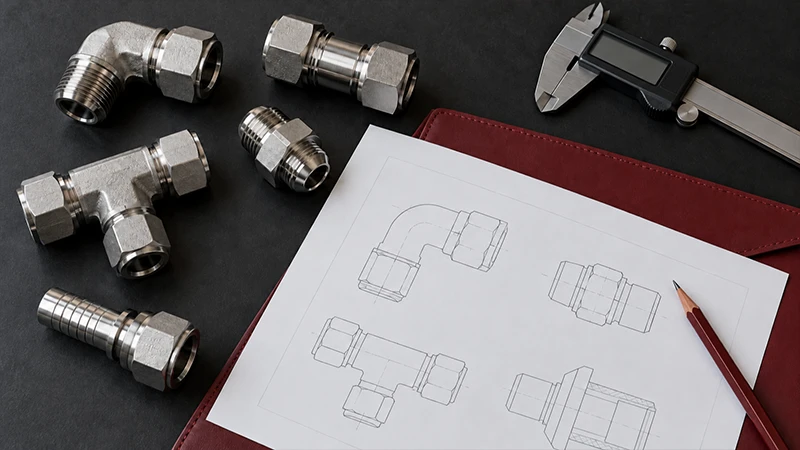
Begin by Defining What You Want to Receive
State whether the enquiry is for an individual adapter, a hose fitting, a ferrule, a set of components or a completed assembly. These scopes may involve similar-looking parts but different quotation information. A supplier cannot reliably infer the intended scope from a close-up photograph.
Explain whether the requirement is a repeat order, a replacement for an unknown part or a component for a new design. For a repeat order, attach the previous reference and identify any changes. For an unknown replacement, make clear which details are observations and which have been confirmed. For a new design, identify the drawing that governs the requirement.
Give the enquiry a reference that your purchasing and engineering teams can both use. Even a simple project name and line-item number will help when photographs, drawings and quotations are exchanged in separate files.
A Hydraulic Fitting RFQ Checklist
The following table is designed for preparing an enquiry, not for approving an installation. Fill in known information and mark unresolved fields clearly.
| Information | What to provide | Why it helps |
|---|---|---|
| Product identity | Full part number, catalogue reference or drawing number and revision | Establishes the intended component or starting point |
| Connection details | End A, End B and any branch: family, size, thread, seal and male/female form | Prevents different interfaces from being treated as equivalent |
| Geometry | Straight or angled body, critical dimensions and orientation | Helps check the required physical configuration |
| Hose or tube | Exact hose identification or tube dimensions, where applicable | Clarifies the assembly interface |
| Operating conditions | Fluid, temperature, working pressure and known peaks | Supports technical suitability review |
| Material requirements | Specified material, finish and seal compound, or clearly stated unknowns | Avoids assumptions based on appearance |
| Quantity and schedule | Quantity per item, sample needs and required arrival date | Defines the commercial requirement |
| Delivery and documents | Destination, requested quotation terms and documentation needs | Makes offers easier to compare |
Provide the Full Part Number and Its Source
Copy a part number exactly, including letters, separators and suffixes. Then say where it came from: a HUALAI directory entry, a previous purchase order, a machine drawing or a marking on the existing component. Different sources carry different levels of certainty.
For example, a family reference from HUALAI’s directory can help locate the relevant category, but the directory is an index rather than a complete dimensional specification. An enquiry should still identify the required size and configuration. Do not expect a family code alone to describe every available variant.
If you have a reference from another manufacturer, label it as a reference for review. Request confirmation against the necessary dimensions and application requirements rather than assuming an automatic equivalent. Where exact replacement is essential, state that substitutions require approval.
Attach a photograph of any marking you transcribe. This gives the supplier an opportunity to catch an ambiguous character without asking you to inspect the part a second time.
Describe Every Connection End Separately
An adapter may have different connection families at its two ends. A tee adds a third interface. Use End A, End B and End C on a sketch, and apply the same labels in the enquiry. This is clearer than listing several thread names in an unexplained sequence.
For each end, provide the known thread designation and pitch, male or female configuration, and sealing arrangement. Distinguish a cone-seat connection from a flat-face connection or a port seal. Include the mating component’s drawing when available, especially if the end cannot be identified confidently from the loose fitting.
Avoid descriptions such as “half-inch fitting” without saying what the size refers to. A hose size, a tube outside diameter and a nominal pipe thread designation do not communicate the same measurement. Preserve the units and terminology used in the controlling drawing.
If these connection families are unfamiliar, use Metric, BSP, JIC & ORFS: Understanding Hydraulic Connections to organise the information before sending the enquiry. You do not need to guess a standard name; it is better to provide clear evidence and ask for identification.
Send Drawings and Photographs That Answer Specific Questions
A drawing should show the dimensions that determine fit and function, along with a drawing number, revision and units. If the drawing is a rough enquiry sketch, identify it as such. Do not present approximate measurements from a used sample as controlled production tolerances.
For photographs, take an overall view, a side view and a clear view of each connection face. Include readable markings and a separate view of any relevant seal or groove. Use neutral lighting so that reflections do not hide the seat or the inside of a nut.
Name the files by enquiry line and view, such as “Item-01-End-A” or “Item-02-Side-View.” A folder full of unrelated camera filenames creates unnecessary work when several similar fittings are being discussed. The naming system should help the supplier associate each image with one quotation line.
Explain which question each attachment resolves. A port drawing may establish the mating interface, while a layout photograph may show restricted access. Neither should be expected to answer the other’s question. RYCO’s technical identification guidance provides a manufacturer reference for checking thread and connector information across different families.
Include Operating Conditions, Even for a Small Component
State the fluid being conveyed and any known compatibility requirements. Describe the required fluid and ambient temperature ranges. Record working pressure separately from known pressure peaks, and preserve the units used in the system documentation. If those values are not available, mark them as requiring engineering confirmation.
For hose assemblies, the STAMPED framework can help organise technical conditions: Size, Temperature, Application, Material being conveyed, Pressure, Ends and Delivery volume. Gates describes this framework in its Hydraulic Hose Products catalogue. The “Delivery” term in that technical framework concerns fluid delivery; your required shipping date should be recorded separately.
Also describe unusual environmental conditions relevant to the enquiry, such as outdoor exposure, washdown or proximity to heat. Do not turn these observations into an unsupported material specification. Instead, communicate the condition and identify any existing approved requirement that the proposed component must meet.
This information helps define the review. It does not mean a general catalogue category has automatically been qualified for the application you describe.
Add Hose and Tube Details Where Applicable
For a hose fitting, include the exact hose manufacturer, series and size whenever known. Attach a photograph of the hose marking. State whether the requirement is for loose components or an assembled hose, and identify who will carry out assembly.
For a completed hose assembly, supply the required length and its measurement convention, the end configurations and the relative orientation of angled ends. If a previous assembly drawing exists, use it and identify the revision. If you are working from a physical sample, explain any uncertainty in the measurements.
For a tube fitting, provide the tube outside diameter and the applicable series or connection specification, together with material and wall information where required by the approved design. Avoid substituting a thread measurement for the tube dimensions.
These details help separate the equipment connection from the hose or tube attachment. For a fuller explanation of the hose categories in HUALAI’s directory, read Swaged, Interlock & One-Piece Hose Fittings.
Specify Materials and Documents Without Inventing Requirements
Where the design specifies a material grade, surface treatment or seal compound, reproduce that requirement accurately. Where it does not, say which information needs a recommendation or confirmation. Colour and appearance are not a reliable basis for naming an alloy, coating or elastomer.
List documentation that is actually required by your purchasing process. Examples may include a dimensional drawing, material documentation, inspection information or an applicable assembly instruction. Ask the supplier to confirm what is available and whether it is included in the quotation.
If a standard or customer specification governs the purchase, provide its exact designation and the applicable revision or edition. Identify the relevant requirement rather than writing a broad request such as “all international certificates.” Specific requests are easier to review and less likely to produce paperwork that does not answer your need.
Make the Commercial Requirement Easy to Quote
Provide quantity by line item. If you need samples before a production order, separate the sample quantity from the expected production requirement. Treat a forecast as a forecast rather than presenting it as a committed purchase.
State the delivery destination and the date you need the goods to arrive. Ask the supplier to distinguish production lead time from transport time and to identify the assumptions behind the proposed schedule. Do not assume that an unconfirmed stock position will remain available until the order is placed.
Include any necessary packaging, identification or labelling requirement. If parts must be packed separately by assembly or project, explain the grouping. Ask quotations to identify currency, freight assumptions, payment terms and any exclusions that affect comparison.
These commercial details belong beside the technical information. A low unit price is difficult to evaluate when different quotations assume different quantities, documents, packing or delivery scope.
A Reusable Hydraulic Fitting Enquiry Email
Adapt the following template to your application. Replace bracketed fields and leave genuinely unknown technical details labelled “to be confirmed.”
Subject: Hydraulic fitting RFQ — [project/reference] — [quantity]
Hello HUALAI team,
Please review the attached information and quote for [individual fittings / components / completed assemblies]. This enquiry is for [a repeat order / a replacement / a new design].
Product reference: [full part number and source, or drawing number and revision].
End A: [connection family, thread and size, sealing arrangement, male/female].
End B and any branch: [corresponding connection details].
Configuration: [straight/elbow/tee, critical dimensions, orientation].
Hose or tube: [exact identification and dimensions, if applicable].
Application: [equipment and function]. Operating conditions: [fluid, temperature range, working pressure and known peaks, with units].
Material, finish and seal requirements: [approved specification or confirmation needed].
Quantity: [per item]. Samples: [requirement]. Required destination and arrival date: [details].
Attachments: [drawing, photographs and supporting documents]. Required quotation documents: [list].
Please identify any missing information and confirm the proposed part specification, quotation scope and lead time. Please list any proposed deviations separately for our review.
Kind regards, [Name, company and contact details]
Review the Reply Before Converting It into an Order
Check that each quoted line refers to the correct drawing or product configuration. Compare quantities, materials, end connections and included documents against the enquiry. If a supplier has proposed an alternative, record that as an alternative until the appropriate person has approved it.
Keep the final technical confirmation with the purchase order. An email clarification that never reaches the order record can be lost when production, inspection or receiving teams take over. A short, controlled specification is more useful than a long conversation with unresolved assumptions.
For future repeat orders, retain the agreed reference and revision together with the quotation. Update the record when the design changes rather than relying on someone to remember the history.
Send a Clear Starting Point to HUALAI
You do not need perfect information before starting a conversation. A full part reference, useful photographs and an honest list of unknowns provide a workable starting point. The goal is to distinguish what is known from what still needs confirmation, then close those gaps before the order is finalised.
Email your hydraulic fitting enquiry to HUALAI with your drawing or product reference, connection details, required quantity and application. Organising those details once can support identification, quotation review and a more consistent purchasing record.