
A hydraulic fitting can look right, accept the first turn of a nut and still be the wrong connection. The difficulty is that a connection has several identifying features: its thread, its sealing surface, its size and the way it joins the surrounding assembly. Recognising just one of those features does not establish compatibility.
For buyers comparing metric, BSP, JIC and ORFS hydraulic fittings, the most useful starting point is to separate how the parts are held together from where the fluid seal is made. Then record both ends of the fitting independently. This approach makes a catalogue search more precise and gives a supplier enough information to check the proposed part against the mating equipment.
This guide explains the main distinctions, shows how they relate to the HUALAI product directory and provides a practical way to prepare an identification enquiry. It is a selection aid; installation dimensions and assembly instructions must come from the approved product documentation.
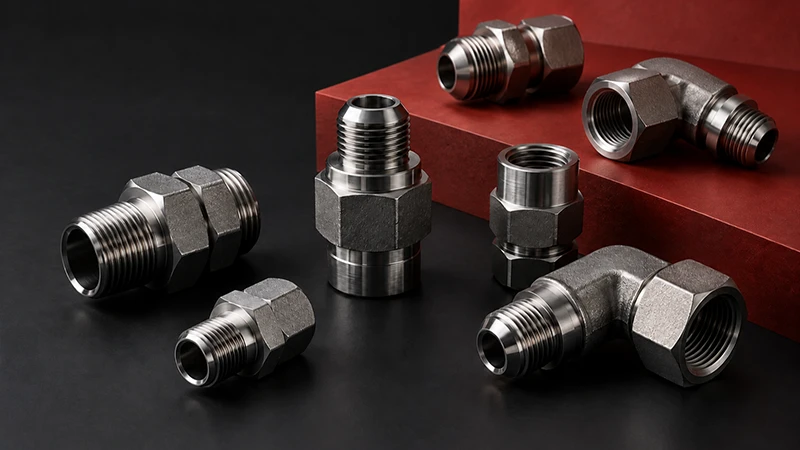
Start with the Thread and the Seal
“Metric” and “BSP” describe thread-related families, while “JIC” and “ORFS” identify more specific connection systems. These labels therefore do not all operate at the same level. A metric-threaded connection may use one of several sealing arrangements. Likewise, identifying a BSP thread does not tell you whether the required joint seals on a cone, at a port face or through a tapered thread arrangement.
In a fitting description, distinguish the external male thread from the internal female thread, then identify the mating surface. Look for a cone, a flat face, a seal groove or a port shoulder. For a removed, safely isolated component, clear photographs of the end face are often more informative than a side photograph showing only the hexagon.
A familiar wrench size is not a reliable identifier. Neither is the fact that two loose components appear to screw together. The relevant question is whether the specified thread and sealing geometry belong to the same approved connection. Parker’s tube fitting training resources distinguish 24° flareless, 37° flare and O-ring face seal systems and also address differences between metric ports.
A Quick Comparison of the Main Families
Use this table to organise the identification process, rather than as an interchangeability chart.
| Connection family | What to identify | Details to include in an enquiry |
|---|---|---|
| Metric bite-type tube fitting | Metric thread, tube connection and series | Tube outside diameter, L or S series, thread size and pitch, mating geometry |
| BSP connection | Parallel or tapered thread and the actual sealing arrangement | BSPP or BSPT designation, nominal size, thread pitch and seat or port detail |
| JIC connection | 37° flare seating system | Thread size and pitch, male or female end, straight or angled body |
| ORFS connection | Flat face sealing system with an O-ring at the male face | Thread designation, face dimensions, seal requirements and end configuration |
The table deliberately leaves out universal pressure ratings. A family name alone cannot provide the rating of a particular size, material, assembly or application. Request the technical information for the exact part being considered.
Metric Hydraulic Fittings: Specify More Than “Metric”
HUALAI’s product directory lists metric bite-type tube fittings in light and heavy series, identified as L and S. The range includes straight connectors, elbows, tees, crosses, bulkhead connections and swivel configurations, together with related nuts and cutting rings. These categories help narrow the search, but “metric straight fitting” is still an incomplete purchase description.
For a tube connection, record the tube outside diameter as well as the thread designation. Include the series and identify what is required on the opposite end. An adapter joining a tube connection to a port needs both interfaces specified; one end cannot be inferred from the other.
The 24° cone is associated with established metric tube connection systems, but an O-ring cone variant and a cutting-ring tube assembly should not be treated as identical simply because they fall within the same broad family. Parker’s industrial tube fitting catalogue provides detailed examples of metric cone ends and associated configurations.
In HUALAI’s directory, H8006L and H8006S appear as straight-fitting references. That makes them useful starting points for a discussion, not complete dimensional specifications for every size. Send the full size requirement and ask for the corresponding drawing before turning a family reference into an order line.
If the old component has no legible marking, describe that uncertainty explicitly. “Metric thread suspected; series not confirmed” is more useful than selecting L or S by appearance. It tells the supplier which point needs checking and prevents a guess from becoming an assumed requirement.
BSPP and BSPT: Similar Names, Different Checks
BSP is short for British Standard Pipe. The distinction most buyers encounter is between BSPP, a parallel thread, and BSPT, a tapered thread. For parallel-threaded connections, the thread normally provides retention while a separate feature provides the seal. The exact sealing arrangement must therefore be identified alongside the thread.
Parker’s Tube Fitting Installation Manual describes BSPP threads with a 55° thread form and discusses separate sealing arrangements, including bonded seals and O-rings. That 55° thread angle is different from the seat angle in a description such as “BSP 60° cone.” The two numbers describe different physical features.
HUALAI’s directory includes BSP 60° cone adapters as well as other BSP-related sealing configurations and transitions involving BSPT or NPT. A buyer should therefore avoid using “BSP fitting” as the entire specification. State whether the enquiry concerns a threaded port connection, a cone-seat connection or another documented arrangement.
Do not silently substitute NPT for BSPT because both names are associated with tapered pipe connections. A transition adapter may deliberately have different families at its two ends, but that is a designed component with separately specified interfaces. It is not evidence that those interfaces are directly interchangeable.
For a replacement elbow, photograph the port side and the hose or tube side separately. Label them End A and End B. This simple practice prevents an enquiry from confusing a BSP-threaded port end with a differently sealed connection on the other side of the same adapter.
JIC Fittings: Understanding 37° and 74° Descriptions
JIC connections are commonly described as 37° flare fittings. The relevant seating surface is measured at 37° to the centreline; the corresponding full included cone angle is 74°. This explains why a catalogue may refer to a JIC 74° cone while an English-language buyer searches for JIC 37° fittings.
HUALAI’s directory uses JIC 74° cone terminology. For an English enquiry, write “JIC 37° flare, shown as 74° included cone in the directory,” and attach the relevant reference or drawing. That preserves the catalogue terminology while making the intended connection clear. RYCO’s JIC 37° flare guide is a useful primary reference for this connection family.
The distinction does not mean that every component described with a 74° cone is automatically JIC. A complete identification still includes the thread and the mating geometry. Similarly, an SAE 45° flare should not be selected as a substitute based on a similar-looking thread or nut.
HUALAI lists straight and elbow JIC adapter families, including references such as H8201J and H8203J. When discussing one of these families, provide the required end sizes and body orientation. If a straight adapter has different sizes at its two ends, show the two callouts on a sketch instead of relying on the order in an informal email description.
ORFS Fittings: Identify the Face Seal
ORFS stands for O-Ring Face Seal. The defining feature is the sealing interface at the face of the connection. In the conventional arrangement, an O-ring retained at the male face seals against the mating flat surface. Parker’s Seal-Lok ORFS product information illustrates this connection family.
ORFS should not be confused with an O-ring boss port connection. Both names involve O-rings, but the location and geometry of the seal differ. An enquiry that says only “SAE O-ring fitting” leaves a substantial identification question unanswered.
HUALAI’s directory separates ORFS fittings from other adapter categories and includes straight and elbow references such as H8301F and H8303F. State ORFS explicitly when that is the required interface, and include the relevant size, material requirement and operating fluid. If an existing seal is missing, do not assume the resulting bare face represents a metal-to-metal sealing design.
Photographs should show the face and groove clearly, without claiming a seal material can be established from colour alone. Where the required elastomer is known from an approved specification, include that specification. Where it is unknown, ask for confirmation based on the fluid and temperature requirements.
A Practical Identification Workflow
Begin with documents rather than measurements. Search for an equipment drawing, bill of materials, previous order or readable part number. Preserve the full reference, including suffixes. A shortened number may identify a family while omitting the information that distinguishes one variant from another.
Next, describe the component’s function and position. Is it connecting a hose to a valve, joining two tubes or passing through a bulkhead? Record the body form: straight, elbow, tee or another configuration. A connection can be correct at both ends and still be unsuitable if its physical form does not fit the available space.
Then record the thread information and sealing details for each end. Keep measured observations separate from confirmed specifications. For example, a note headed “approximate measurement from used sample” should not be presented as the same quality of evidence as a controlled drawing dimension.
Finally, request confirmation of the complete proposed part. Ask the supplier to identify unresolved points rather than allowing missing details to disappear into a quotation. RYCO’s thread and connector identification guidance similarly treats identification as a process involving multiple features, rather than a single visual match.
Common Questions Before Ordering
Does the Same Thread Size Mean Two Fittings Are Compatible?
No. Matching thread information is only part of the check. The sealing interface, dimensions, intended mating part and application requirements also need to agree. Treat an apparent thread match as a clue to investigate, not as approval to install the connection.
Can a Catalogue Picture Replace a Drawing?
A catalogue picture is useful for recognising the general shape. It normally cannot establish every dimension, the exact seal arrangement or the configuration of an unseen end. Ask for a drawing when those details determine whether the part fits your equipment.
What If the Existing Fitting Has No Part Number?
Send clear photographs of both ends, a side view, available measurements and the equipment information. Mark uncertain details as unknown. A supplier can then explain which additional measurements or documents are needed before proposing a replacement.
Turn Identification into a Clear Enquiry
For HUALAI, the most useful initial enquiry combines a directory reference or drawing with the required sizes, connection details, quantity and application. Include both ends, even when one seems obvious. This gives the discussion a defined technical starting point and reduces the chance of comparing quotations for different configurations.
If the fitting will be attached to a hose, continue with Swaged, Interlock & One-Piece Hose Fittings. For a structured purchasing checklist, use What to Include in a Hydraulic Fitting Enquiry.
Ready to identify a part? Send your drawing, part number or sample photographs to HUALAI and list any details that still need confirmation.